Distribution Centers Are More Interesting Than You'd Think

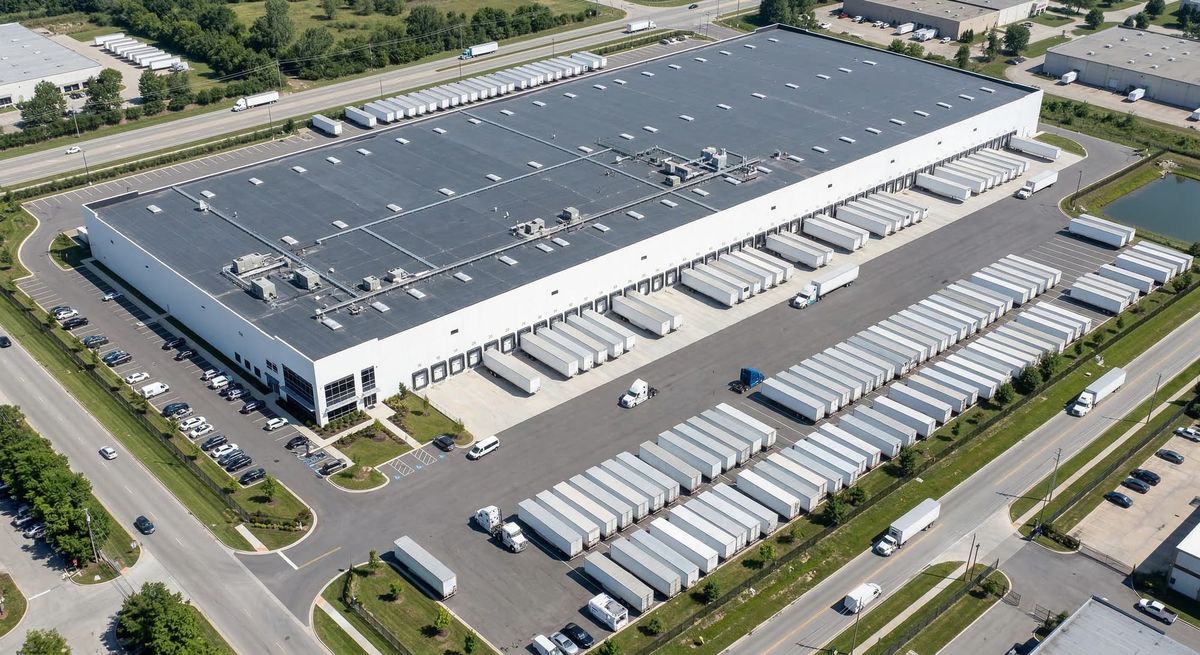
I'll be upfront about something. When I was studying supply chain management in college, distribution centers were not the thing keeping me up at night. I was drawn to the better marketed side of the discipline. Constant travel to work with international suppliers, writing code to build demand forecasting models, using simulation to optimize inventory strategies. I wanted to be the guy with the clean dataset and a sharp story to tell the room. Warehousing? That was the part of the supply chain I figured someone else would worry about.
And now, coming up on a decade of designing warehouse systems and planning distribution facilities across the United States, I've realized something that none of my professors ever quite sold me on: distribution centers are one of the most fascinating, complex, and strategically critical pieces of any supply chain. And they are wildly underappreciated.
I get it. Nobody is telling stories about pallet rack configurations. But stick with me for a few minutes, and I think I can change your mind.
The Unsung Buffer
If you've studied or have ever touched queueing theory or systems engineering, perhaps have worked on process mapping or you know what a buffer is. It's a point in a system that absorbs variability between two processes operating at different speeds. Without it, the faster process overwhelms the slower one, the slower one starves the faster one, and the whole thing grinds to a halt.
A distribution center is a buffer. A really big, often a really expensive, really important buffer.
On one side, you have supply: production schedules, ocean container shipments, vendor lead times, all moving to their own cadence and rhythm. On the other side, you have demand: customer orders arriving in unpredictable volumes, with unpredictable product mixes, at unpredictable times. These two sides almost never move in sync. The DC sits between them, absorbing the mismatch so that neither side breaks.
This isn't just a warehouse metaphor I'm stretching to sound smart. It's the actual engineering function of the facility. A well-positioned distribution center decouples supply from demand. It lets you receive a container of product on Tuesday and fulfill 200 individual orders from it by Thursday without the customer ever knowing or caring when that container showed up. It transforms a rigid, push-driven supply chain into something responsive and fluid.
Remove that buffer, and you're left with two options: carry massive inventory everywhere to cover for uncertainty, or accept that you're going to miss service levels on a regular basis. Neither is a winning strategy.
A Challenging and Cool Technical Problem
Here's where I started falling in love with this work, and I say that without a hint of irony.
A distribution center is a system of systems. Receiving, putaway, storage, replenishment, order picking, packing, sorting, shipping, so forth.. Each one is its own process with its own throughput rate, its own variability profile, and its own capacity constraints. And they all have to work together in a coordinated flow, thousands of times per day, without falling apart.
The planning problems here are complex. How do you zone or slot 30,000 SKUs across multiple storage media to minimize travel time while maintaining ergonomic pick heights and staying within fire code setback requirements? How do you sustain this throughout the year with seasonal fluctuations and customer demand changes? How do you size a conveyor sortation system to handle peak-season throughput without overbuilding for the other ten months of the year? How do you design wave planning logic that keeps labor balanced across zones without creating downstream bottlenecks at packing and shipping?
These aren't back-of-the-napkin exercises. Among many things, one must perform analysis of product behavior, customer order structure, inbound and outbound shipment profiles, and seasonal demand patterns. The data work alone is substantial. And the design decisions that flow from it are deeply consequential.
I've worked on facilities where straightforward analysis led to a footprint reduction of half the operations original size which also led to improvements in throughput given the reduction in order picking travel. Just think of the real estate savings alone?
If you're someone who likes solving hard problems with real data and real constraints, warehouse engineering is a goldmine. I just wish someone had told me that in school. As a data nerd, warehouses often keep fairly organized records of transactions and products given the vast adoption of software such as ERP and WMS.
The Stakes Are Real
Distribution centers are not cheap. A greenfield facility build can easily run into the tens to hundreds of millions when you factor in the building, the racking, the material handling systems, the automation, and the IT infrastructure required to run it all. Even a retrofit or expansion of an existing building can be a multi-million dollar commitment.
And unlike a bad software deployment where you can roll back a release (even if painfully), a poorly designed warehouse is something you live with for years. You can't easily move a structural mezzanine. You can't reroute miles of conveyor backbone without a major capital project. You can't simply undo a racking layout once 40,000 pallet positions are loaded with product and your team has built their entire operation around it.
This is what makes the planning phase so critical. The decisions made in the first few months of a facility design project lock in the operational performance and cost structure for the next 5-10 years, perhaps longer. Get the storage strategy wrong, and you'll be out of capacity in under a year. Undersize the shipping dock, and you'll have trailers stacked up in the yard every peak season. Overlook fire protection requirements under IBC, IFC, or NFPA 13, and you're dealing with code compliance issues that can shut down an operation entirely.
I've seen organizations treat facility planning as a quick exercise, something to knock out in a few weeks so they can move on to the "real work" of going operational. That approach almost always ends up costing more than doing the upfront analysis right. Every time.
When Boston Dynamics decided it was time to chase real revenue at scale, they built a robot called Stretch and pointed it at warehouses. It sold out before it shipped.
The Front Line of Innovation
Here's the part that would have surprised 22-year-old me the most: distribution centers are where some of the most exciting technological innovation is happening right now.
Think about it. A warehouse or distribution center is a controlled environment with repeatable processes, measurable outputs, and a relentless pressure to do more with less. That's the perfect proving ground for automation and robotics.
Autonomous mobile robots moving inventory to pick stations. Robotic arms handling piece-level picking and packing at speeds no manual operation can match. Automated storage and retrieval systems operating at storage densities that would be physically impossible with conventional racking. Machine vision systems performing quality checks at line speed. Humanoids moving totes. This isn't a trade show demo reel. This technology is running in production facilities today, and it's actively reshaping what's possible in distribution. Often the warehouse is the first real-world proving ground to test whether a technology is not only functional, but also economically feasible. When Boston Dynamics decided they finally needed to make money, where did they commercially deploy? Construction monitoring and warehouse automation.
What makes it interesting from an engineering perspective is that warehouse automation isn't just about swapping a manual task for a robot. It's about redesigning the entire system around new capabilities. A goods-to-person system doesn't just change how you pick. It changes your storage strategy, your slotting logic, your labor model, your building footprint requirements, and your throughput ceiling. The ripple effects are enormous, and designing around them well is some of the most challenging and rewarding work in the industry.
Every year, the technology continues to become more capable, more affordable, more flexible, and more accessible to mid-market operations that couldn't have justified it five years ago. The organizations paying attention to this space are building distribution networks that will outperform their competitors for a decade. The ones that aren't will eventually wonder why they can't keep up.
Distribution Deserves More Respect
The distribution center is not just a building where you keep stuff until someone orders it. OK, simply put, yes it is. But dig a little deeper. It's like listening to "Message in a Bottle" by The Police. On the surface, it's a catchy tune. But when you actually pay attention, you realize the guitar, bass, and drum parts are all individually incredible. Distribution is the same way. It's a strategic buffer that keeps supply and demand from tearing each other apart. It's a complex system that rewards rigorous engineering and punishes shortcuts. It's a high-stakes capital investment that can make or break the economics of an entire supply chain. And it's a platform for innovation that's evolving faster than most people in the industry realize.
I didn't appreciate any of this when I started my career. I thought the interesting work was upstream, in sourcing and planning and analytics. I wasn't wrong that those things are interesting. But I was completely wrong to assume that the physical network, the actual facilities where product moves through space, was somehow less intellectually stimulating or strategically important.
It's not. If anything, it's where you can directly watch theory meet reality. And there are few things more rewarding than watching something come to life from theory to reality.
